
The failure mode is almost always the same: a business treats IT strategy as a technology problem, hands it to whoever manages the technology, and wonders why the output doesn’t connect to what the business actually needs.
IT strategy isn’t a technology problem. It’s a business problem that requires technology expertise to solve. Getting that framing right is the difference between a strategy that drives competitive advantage and one that generates a long document nobody refers to.
The Common Mistakes in IT Strategy
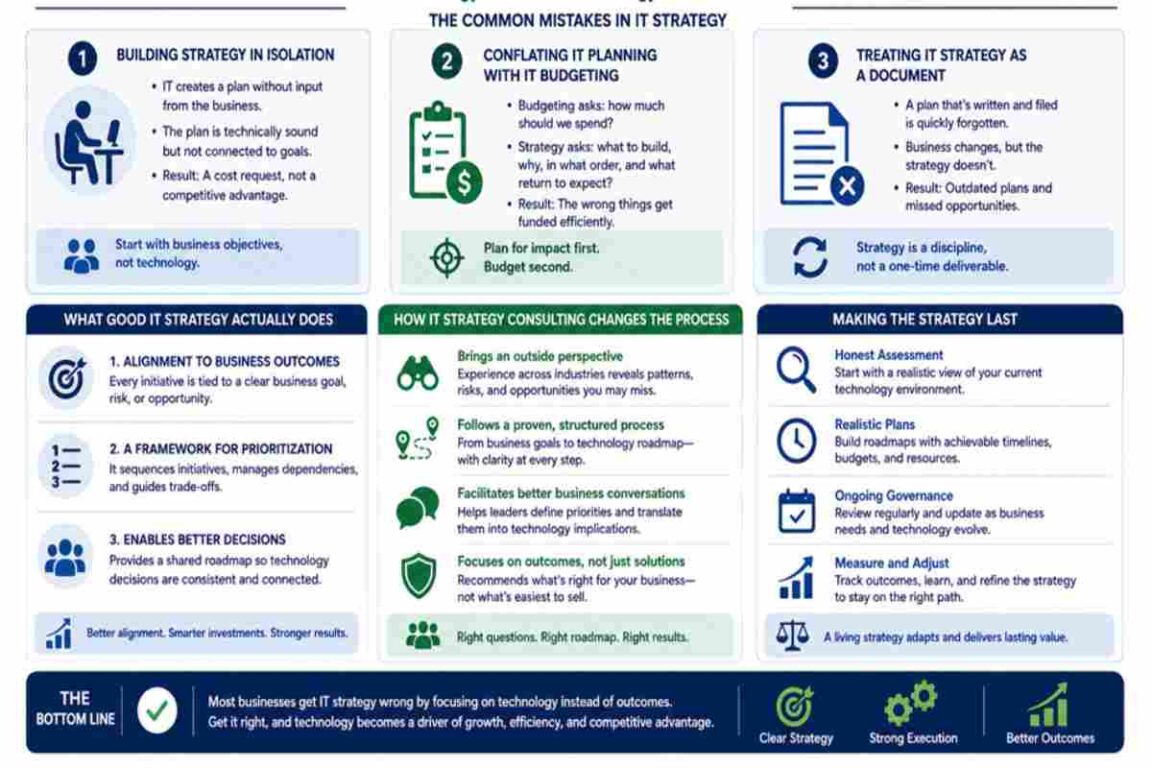
The first mistake is building strategy in isolation. The IT team sits down, assesses the technology environment, identifies gaps and upgrade paths, and produces a plan. This plan is technically coherent. It addresses real infrastructure needs. And it lands with leadership as a cost request with limited connection to anything they’re trying to accomplish.
The problem isn’t the analysis. It’s the starting point. IT strategy built from the technology outward rarely produces the same answer as strategy built from business objectives inward. When you start with the technology, you optimize for the technology. When you start with the business goals, you optimize for the business — and technology becomes the means to an end rather than an end in itself.
The second mistake is conflating IT planning with IT budgeting. These are related but different. Budgeting asks how much to spend. Strategy asks what to build, in what order, for what purpose, and with what expected return. Organizations that skip directly to budgeting often fund the wrong things efficiently and underfund the right things.
The third mistake is treating IT strategy as a document rather than a discipline. A strategy that gets written, presented, approved, and filed is not a strategy in any meaningful sense. A functioning IT strategy is a living set of priorities and commitments that gets revisited regularly, updated as the business changes, and used to evaluate technology decisions as they arise.
What Good IT Strategy Actually Does
Effective IT strategy performs three functions that most technology planning misses.
First, it creates alignment between technology investment and business outcomes. Every initiative in the strategy has a clear connection to a business goal: this investment supports our expansion into new markets, this security investment manages a risk that is material to our client relationships, this platform migration enables the workflow changes needed to improve our margin. When that connection exists, technology decisions become business decisions — and they get the attention and resources they warrant.
Second, it creates a framework for prioritization. Growing businesses constantly face competing technology needs. A good IT strategy doesn’t just list what needs to happen — it sequences it, explains the dependencies, and provides a basis for making tradeoffs when resources are constrained. This is the most practical value of having a strategy: it turns a list of technology needs into a coherent plan with clear priorities.
Third, it enables informed decision-making across the organization. When leaders, department heads, and managers understand the technology roadmap, individual decisions — adopting new software, requesting new capabilities, planning a workflow change — get made against a shared frame of reference. Technology decisions stop being made in silos and start connecting to a common plan.
How IT Strategy Consulting Changes the Process
The reason many businesses turn to external expertise for IT strategy is not that they lack internal technical knowledge. It’s that they lack the combination of business perspective, technology expertise, and strategic methodology that makes the strategy valuable rather than just comprehensive.
Good it strategy consulting brings an outside perspective that internal teams often struggle to generate. Consultants who’ve worked across multiple organizations have seen the patterns — they know which technology investments tend to produce strong returns, which common mistakes are expensive to reverse, and what the path from the current state to the target state typically looks like for a business at a given stage.
They also bring a structural process for building strategy that connects the right questions to the right sequence: Where is the business going? What does the technology environment need to look like to support that trajectory? What’s the gap between current and target? What’s the order of operations for closing it?
This process sounds straightforward. In practice, most organizations find it harder than expected to answer the first question — “where is the business going?” — in terms specific enough to derive technology implications. An experienced strategy partner can facilitate that clarity in ways that make the technology decisions that follow significantly easier.
Making the Strategy Last
The strategies that deliver sustained value share a few characteristics that are worth building toward from the beginning.
They’re grounded in honest assessment of the current state. A strategy that starts with an optimistic picture of existing infrastructure will produce recommendations that don’t match reality. The baseline assessment should be rigorous, even when the results are uncomfortable.
They’re built with realistic timelines and resource assumptions. An ambitious technology roadmap that requires capabilities or budget the organization doesn’t have isn’t a strategy — it’s a wish list. Effective strategy is calibrated to what’s actually achievable.
They have a governance process for staying current. At minimum, the strategy should be reviewed quarterly and updated when business circumstances change significantly. The technology decisions the strategy was built to guide are happening continuously — the strategy needs to be current enough to guide them.
And they’re measured. Not perfectly, not with false precision, but against clear indicators of whether the technology investments are producing the business outcomes they were designed to support. This feedback loop is what allows the strategy to improve over time rather than just being produced and forgotten.
IT strategy done well isn’t complicated. It’s disciplined. It requires the willingness to connect technology decisions to business outcomes, to plan before the need is urgent, and to revisit the plan as conditions change. Most organizations are capable of it. The ones that invest in doing it well have a meaningful and compounding advantage over the ones that don’t.