
Growth is exciting—until your systems start breaking under pressure.
At first, spreadsheets work. Then they don’t. Finance teams start patching processes together. Reporting takes longer. Errors creep in. Suddenly, what used to take an afternoon now eats up an entire week.
Sound familiar?
As companies scale, accounting becomes less about bookkeeping and more about control, visibility, and decision-making. Choosing the right accounting platform isn’t just a technical decision—it shapes how confidently a business can grow.
Let’s break it down.
Scaling Finance Challenges: Where Things Start to Crack
Growth doesn’t just add revenue. It adds complexity.
A lot of it.
Multi-Entity Chaos
Expanding into new regions or launching subsidiaries sounds great—until consolidation becomes a nightmare.
Finance teams often deal with:
- Different currencies
- Varying tax rules
- Separate ledgers
- Disconnected reporting timelines
Without the right system, closing the books across entities can take weeks.
Manual Processes That Don’t Scale
Early-stage teams rely heavily on manual inputs:
- Spreadsheet reconciliations
- Manual invoice processing
- Hand-built financial reports
It works… until volume increases.
At that point, manual work doesn’t just slow things down—it introduces risk.
Reporting Delays
Leadership wants answers. Fast.
But if your system can’t deliver real-time insights, you’re stuck reacting instead of planning.
That’s a problem.
Why the Shift Toward Cloud Accounting Platforms
There’s a reason the market is growing fast.
According to Stellar Market Research, the accounting software market was valued at $14.98 billion in 2024 and is expected to reach $28.27 billion by 2032, growing at a CAGR of 8.26%.
That’s not random. It reflects demand.
And cloud platforms are a big part of that shift.
Flexibility Over Rigidity
Legacy systems were built for stability, not adaptability.
Cloud systems? Different story.
They allow:
- Remote access
- Real-time updates
- Easier integrations with other tools
Teams can work from anywhere. Finance data is always current.
Cost Efficiency
Cloud accounting adoption isn’t just about convenience—it impacts the bottom line.
A study published in the Journal of Innovation & Entrepreneurship found that businesses adopting cloud accounting saw measurable improvements in operational efficiency and cost reduction.
Less manual work. Lower infrastructure costs. Faster workflows.
Simple.
Measurable Performance Gains
Another empirical study on cloud accounting adoption found that companies using cloud systems reported higher financial performance (mean score 4.1 vs. 3.3 for non-adopters), with strong statistical significance (t = 5.24, p < 0.01).
The drivers?
- Operational efficiency (β = 0.43)
- Ease of use (β = 0.42)
- Cost savings (β = 0.38)
Those aren’t abstract benefits. They’re measurable.
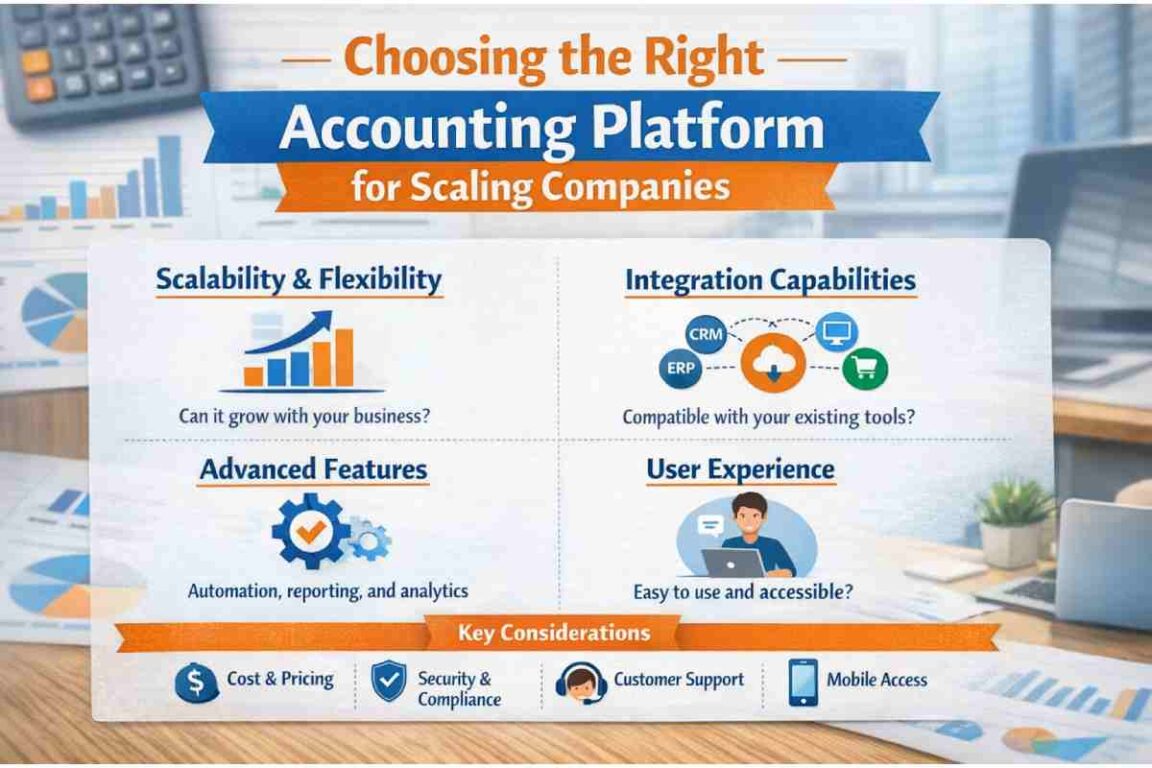
Key Features to Evaluate Before Choosing a Platform
Not all accounting systems are built for growth.
Some look good on paper but fall apart when complexity increases.
Here’s what actually matters.
Multi-Entity Management
If you’re scaling, this isn’t optional.
Look for:
- Consolidated reporting across entities
- Automated intercompany eliminations
- Multi-currency support
If your system can’t handle this cleanly, you’ll feel it quickly.
Automation Capabilities
Automation reduces errors. It also frees up your team.
Prioritize systems that support:
- Automated invoicing
- Bank reconciliations
- Recurring journal entries
- Approval workflows
Less manual work = more time for analysis.
Real-Time Financial Reporting
Waiting days (or weeks) for reports? That’s a red flag.
Strong platforms provide:
- Live dashboards
- Customizable reports
- Drill-down capabilities
Decision-making improves when data is immediate.
Integration Ecosystem
Your accounting system doesn’t operate in isolation.
It needs to connect with:
- CRM platforms
- Payroll systems
- Inventory tools
- Payment processors
The more integrations available, the easier your workflows become.
Scalability
Ask yourself one question:
Will this still work in two years?
If the answer isn’t clear, keep looking.
Comparing Platform Categories: What Are Your Options?
There’s no one-size-fits-all solution. Different platforms serve different needs.
Let’s break them into categories.
Entry-Level Cloud Accounting Tools
Think QuickBooks, Xero, and similar tools.
Best for:
- Small teams
- Simple financial structures
Limitations:
- Struggle with multi-entity setups
- Limited customization
They’re great—until they’re not.
Mid-Market Systems
These platforms sit between basic tools and enterprise systems.
They typically offer:
- Better reporting
- More automation
- Some multi-entity functionality
Good for growing companies—but may still require workarounds at scale.
Enterprise Resource Planning (ERP) Systems
This is where things get serious.
ERP platforms like NetSuite offer:
- Advanced consolidation
- Deep customization
- Full financial control
But they come with trade-offs:
- Higher cost
- Longer implementation timelines
- Complexity
That’s why many businesses explore popular alternatives to NetSuite to find solutions that balance capability with usability.
Because bigger isn’t always better.
Implementation Considerations: What Most Teams Overlook
Choosing a platform is one thing.
Implementing it? That’s where things often go wrong.
Short-Term Disruption Is Normal
Switching systems can temporarily affect performance.
Research published in the International Journal of Financial Studies found that digital transformation efforts initially had a negative impact on accounting information system quality, with coefficients as low as −0.687 in early stages.
In plain terms?
Expect friction at the beginning.
It doesn’t mean the decision was wrong.
Data Migration Complexity
Moving data isn’t just a technical task—it’s a strategic one.
You’ll need to:
- Clean historical data
- Map accounts correctly
- Validate accuracy
Mistakes here can ripple through reports for months.
Team Training
Even the best system fails if no one knows how to use it.
Training should include:
- Role-specific workflows
- Reporting capabilities
- Troubleshooting basics
Don’t rush this part.
Choosing the Right Implementation Partner
Some platforms require external support for setup.
A good partner can:
- Reduce implementation time
- Help avoid costly mistakes
- Customize workflows effectively
A bad one? The opposite.
Long-Term Benefits of Choosing the Right Platform
Get this decision right, and the impact compounds over time.
Faster Financial Close
Instead of weeks, you’re looking at days—or even hours.
That changes how teams operate.
Better Decision-Making
When leaders have real-time data, decisions improve.
It’s that simple.
Reduced Operational Burden
Automation cuts down repetitive work.
Finance teams shift from data entry to analysis.
That’s a big upgrade.
Improved Compliance and Accuracy
With built-in controls and audit trails, errors decrease.
And audits? Much smoother.
Room to Grow
The right system doesn’t just support where you are—it supports where you’re going.
That matters.
Final Thoughts
Scaling a business puts pressure on every system you rely on. Accounting is no exception.
What worked at $1M in revenue won’t hold up at $10M. And what worked at $10M might break at $50M.
That’s the reality.
The key is choosing a platform that grows with you—one that handles complexity without slowing you down.
To recap:
- Growth introduces multi-entity complexity, manual bottlenecks, and reporting delays
- Cloud accounting platforms offer flexibility, cost benefits, and measurable performance gains
- Features like automation, integrations, and real-time reporting aren’t “nice to have”—they’re necessary
- Different platform categories serve different stages of growth
- Implementation requires planning, patience, and the right support
- The long-term payoff includes faster closes, better insights, and stronger financial control
No system is perfect. But the right one makes everything else easier.
And when finance runs smoothly?
Everything else tends to follow.